Thursday, October 1, 2020 by C. Michial Jones
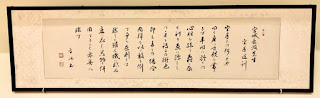
On the rear wall of the Jundokan So-Honbu dojo in Okinawa hangs a framed piece of shodo (calligraphy). To the casual observer, it is a beautiful piece of art; to the dedicated practitioner, it is the distilled essence of the Goju-Ryu spirit.
This calligraphy, known as the Miyagi Chojun Sensei Karate-do Kun, serves as the founder’s definitive answer to a foundational question: What is Karate?
The Translation
The text provides a balanced view of the martial arts, emphasizing that the practice is as much about the “ordinary” days of peace as it is about the “emergencies” of conflict:
“In ordinary times, it is an art in which to cultivate one’s spirit and physical health, and in times of an emergency, it is a way of protecting oneself without carrying a weapon. That is, in many cases, we principally fight with our bodies to defeat our opponents; however, according to the timing and circumstance, it is not impossible to use implements as well.”
From Essay to Shodo
While this text is famously displayed at the Jundokan, its origins lie in Miyagi Sensei’s seminal 1936 essay presented to the Dai Nippon Butokukai.
The essay, titled Ryukyu Kenpo Karatedo Enkaku Gaiyo (An Overview of the History of Ryukyu Kempo Karatedo), is often abbreviated to Karatedo Gaisetsu. This document remains one of the most important pieces of literature in martial arts history, providing the blueprint for Goju-Ryu’s evolution and its place within the broader Japanese budo landscape.
A Legacy in Print
The wisdom of Miyagi’s 1936 essay was preserved for future generations by his senior students and peers. It appeared as a supplementary article in two landmark texts:
- 1975: Okinawa no Karatedo by Shoshin Nagamine Sensei.
- 1979: Okinawa-den Gojuryu Karate-do by Eiichi Miyazato Sensei.
For Western practitioners, a pivotal moment occurred in 1999, when Patrick McCarthy Sensei published an English translation, finally making Miyagi’s specific vision accessible to the global community.
Conclusion
The Karate-do Kun is a reminder that Goju-Ryu is a holistic system. It is a vehicle for physical health and spiritual cultivation, yet it retains the sharp, practical edge of self-defense. For those who walk the path of the “Hard and Soft,” these words are a North Star, guiding our training both on and off the mat.
While this historic piece of Shodo may largely go unnoticed by many that can not read the original kanji, a beautiful rendering of the kanji complete with an English translation can be purchased here.
No responses yet